
Defense IP Licensing · WOSB

CAGE: 1ZVH8 · UEI: SSF2KHHWYVL9

Physical-Layer Safety for Autonomous & Mission-Critical Systems

STATIC-KINETIC architects deterministic safety IP. The KINETIC-369 framework embeds critical constraints in physical mechanisms — unprogrammable CMOS logic, material geometry, and energy pathways — so the final actuation constraint is not dependent on software, firmware, or network connectivity alone.

<200µsResponse Latency
HSK-01Hardware Safety Kernel
DoDD3000.09 Pathway
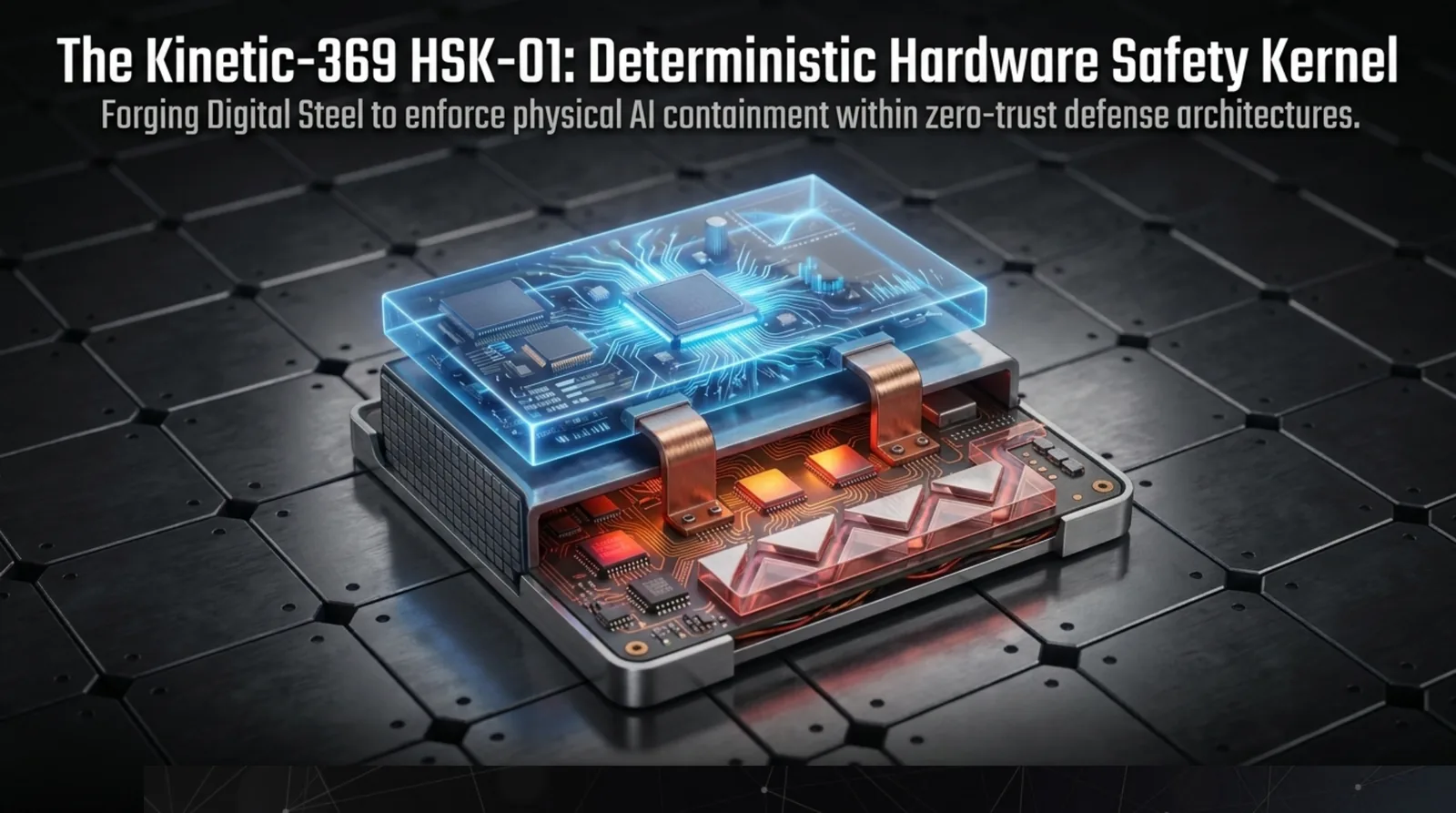
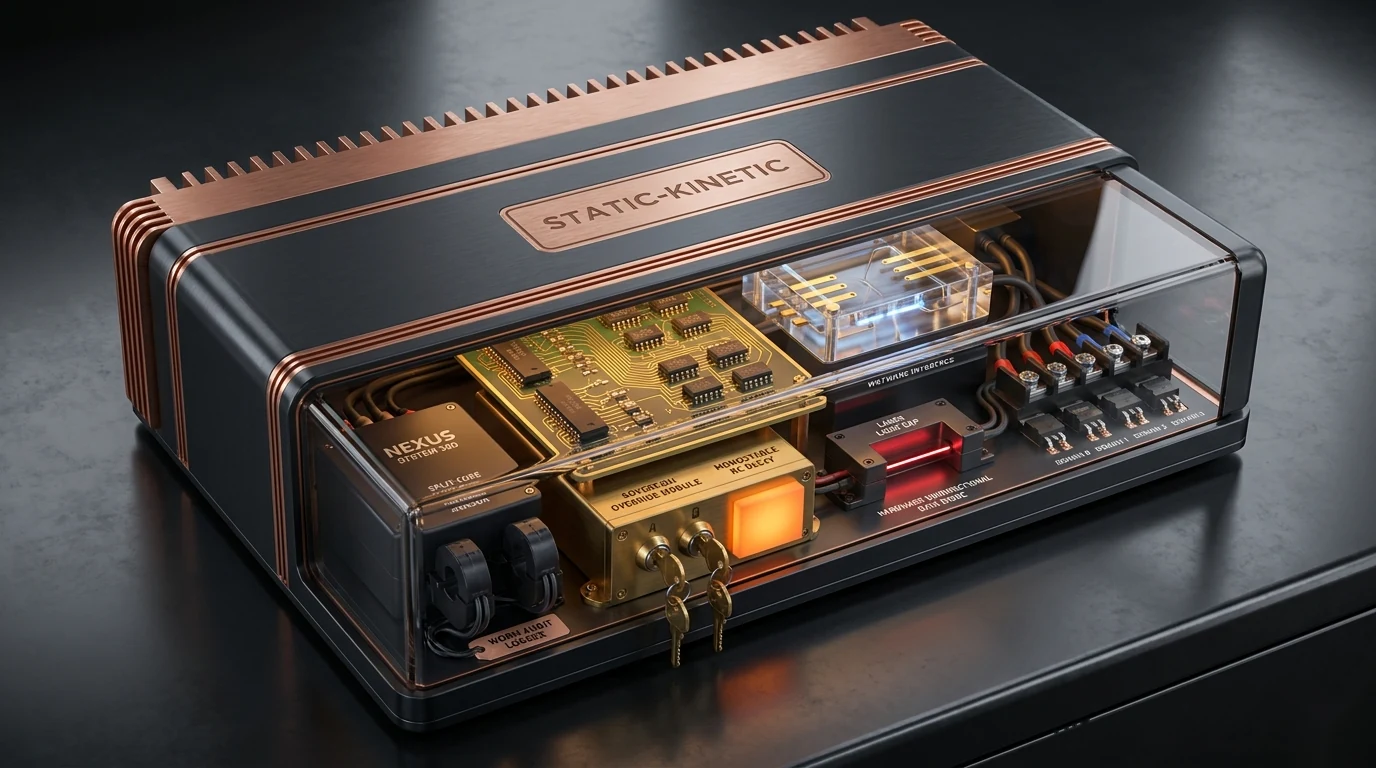
Three-dimensional rendering of the KINETIC-369 HSK-01 hardware safety system in a black and copper enclosure with its internal circuitry visible
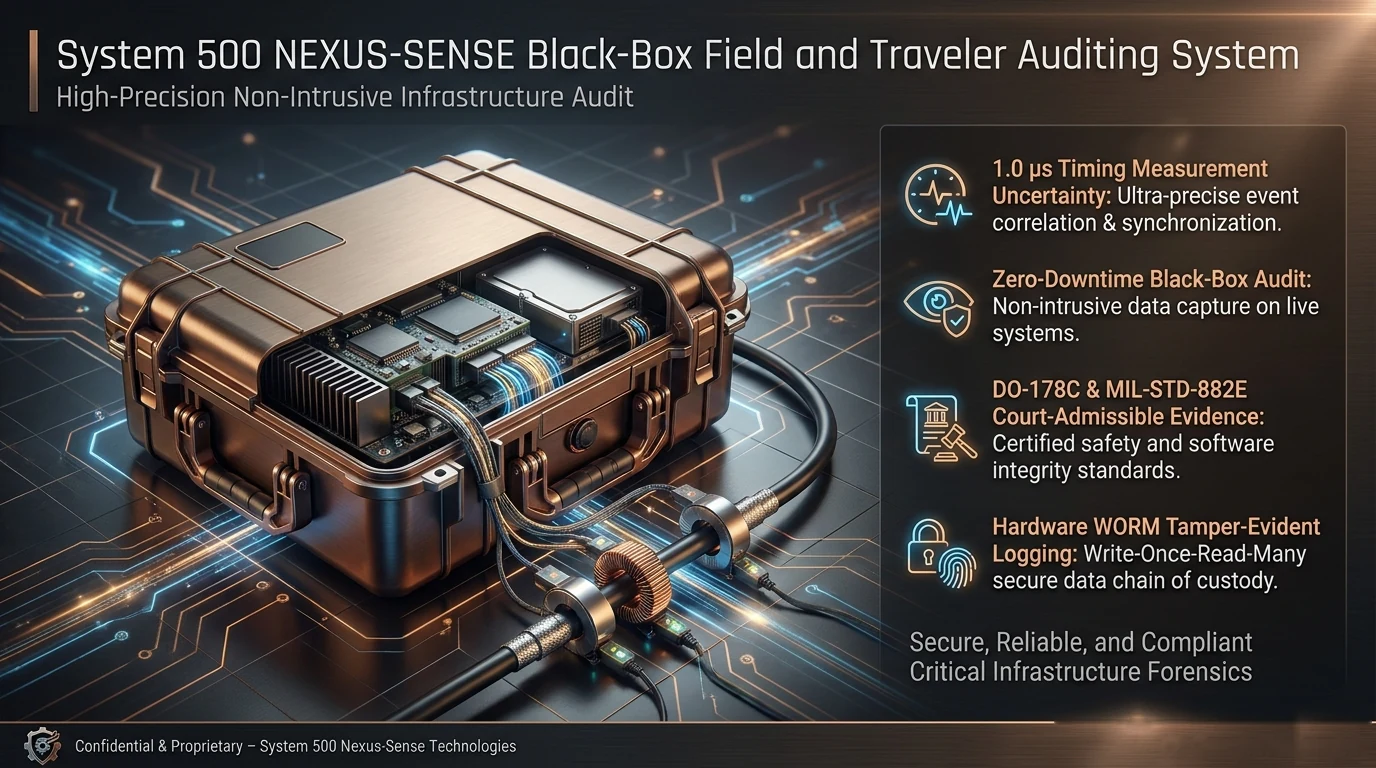
System 500 NEXUS-SENSE field and traveler auditing system shown as a rugged copper instrument case with technical callouts
CDAO Tradewinds Solutions Marketplace Awardable badge

View Marketplace Listing

Awardable ID 2afb51f4

DoD CDAO · Tradewinds Solutions Marketplace

Awardable Status Announcement

STATIC-KINETIC LLC, based in Spokane, Washington, has officially achieved “Awardable” status on the DoD CDAO's Tradewinds Solutions Marketplace (Awardable ID: 2afb51f4) for its KINETIC-369 hardware safety architecture.

Acquisition Pathway Reference

This designation, effective August 19, 2026, reflects a Tradewinds marketplace assessment conducted through competitive procedures. Whether those procedures satisfy Competition in Contracting Act (CICA) requirements where CICA applies, or support a direct, sole-source Prototype OTA or Phase III SBIR award for military testbed integration, must be determined and documented by the warranted agreements or contracting officer for the specific acquisition.

Status clarification. Awardable status identifies the solution as available through the Tradewinds acquisition pathway. It does not by itself represent a contract award, endorsement, certification, or commitment by the Department of Defense or any government agency. Any procurement is subject to sponsor requirements, applicable authority, and executed award documentation. Awardable status does not establish entitlement to a sole-source award, satisfy procurement-specific eligibility conditions, or replace the warranted official’s independent competition determination, justification, and approval for the acquisition at issue.

Awardable Presentation · 5 Minutes
7-26-3162 | KINETIC-369: Deterministic Hardware-Enforced Safety for a Defined Actuation Path

Download video
Why This Matters Now

Software Can Be Updated.
Physical Constraints Have to Be Engineered.

AI systems are increasingly capable of making decisions that affect physical systems. Traditional cybersecurity protects digital systems from unauthorized access. We address a different layer: the final safety constraint must exist outside the software execution domain, or it can be rewritten by the same stack it is meant to protect.

Digital Intelligence

  • AI models
  • Software
  • Firmware
  • Networks
  • Algorithms
↓ Enforced by ↓

Physical Enforcement

  • Geometry
  • Material constraints
  • Mechanical states
  • Energy pathways
  • Physical interlocks
  • Hardware-defined boundaries

The point is not that software is unnecessary. The point is that a digital system should not be able to rewrite a safety constraint that has been physically embodied outside the software execution layer.

Philosophy & Architecture

We do not police the mind; we interrupt the muscle.

Securing the Last Inch: The Digital-to-Physical Translation Point.

Frontier AI is trapped in the digital realm. To cause a real-world catastrophe — blowing a pipeline, crashing a grid, or inducing thermal runaway — software must eventually translate into an electrical voltage to move a physical actuator.

That last inch is where the KINETIC-369 Hardware Safety Kernel (HSK-01) waits. We do not attempt to outsmart a trillion-parameter model, nor do we solve digital data theft, in-envelope commands, other unprotected actuators, or a compromised human restore path. Residual risk remains on other actuators, lying sensors, commands still inside the wired envelope, and the human who can restore the latch. Instead, we enforce hardwired physical envelope thresholds using discrete, unprogrammable 74HC CMOS logic. If a software command violates the physical envelope, the hardware severs the actuator’s power path in under 200 microseconds. Software cannot negotiate with physics.

Hardwired circuit break — signal path

SOFTWARETHE LAST INCHACTUATORPWRDE-ENERGIZED

Status: animation paused — actuator de-energized

The breaker blade sits physically between the software domain and the actuator power path. There is no programmable element in the break — only discrete 74HC CMOS logic enforcing the physical envelope.
KINETIC-369

One Architecture. Multiple Implementations. Multiple Markets.

KINETIC-369 is the core hardware-enforced safety framework. The modules below are implementations of the same physical-layer principle: critical constraints belong in mechanisms that software cannot rewrite.

STATIC-KINETICThe company — pure-play safety IP strategy.KINETIC-369The core architectural framework.Core TechnologiesPhysical enforcement · verification · fail-safe mechanisms · sovereign control architecture.System ModulesHSK-01 · SOM · NEXUS-SENSE · Bio CIP.ApplicationsDefense · autonomous systems · energy · space · critical infrastructure · industrial systems.
MODULE 1

The Core Kernel (HSK-01)

Brownfield plug-and-play deterministic safety. Operates downstream of host environments, providing a sub-200µs hardware-enforced interrupt on the actuation path for brownfield SCADA and facility control, without replacing legacy control code.

MODULE 2

The Sovereign Override Module (SOM)

Sovereign Override Module. Enforces DoD Directive 3000.09 human-in-the-loop authority using dual-key Z-Scan impedance and passive analog RC decay circuits designed to remove software-mediated override paths.

MODULE 3

The Verification Harness (NEXUS-SENSE)

Non-invasive black-box auditing. A zero-footprint test apparatus that injects cryptographic boundary faults to compile MIL-STD-882E-aligned compliance evidence without exposing proprietary AI models.

MODULE 4

The Frontier Defense (Bio CIP)

Post-quantum wetware isolation. Secures automated biological synthesizers using lattice-based post-quantum cryptographic enclaves and physical impedance verification, so sequence clearance cannot be asserted without matched physical presence.

Frontier Biosecurity

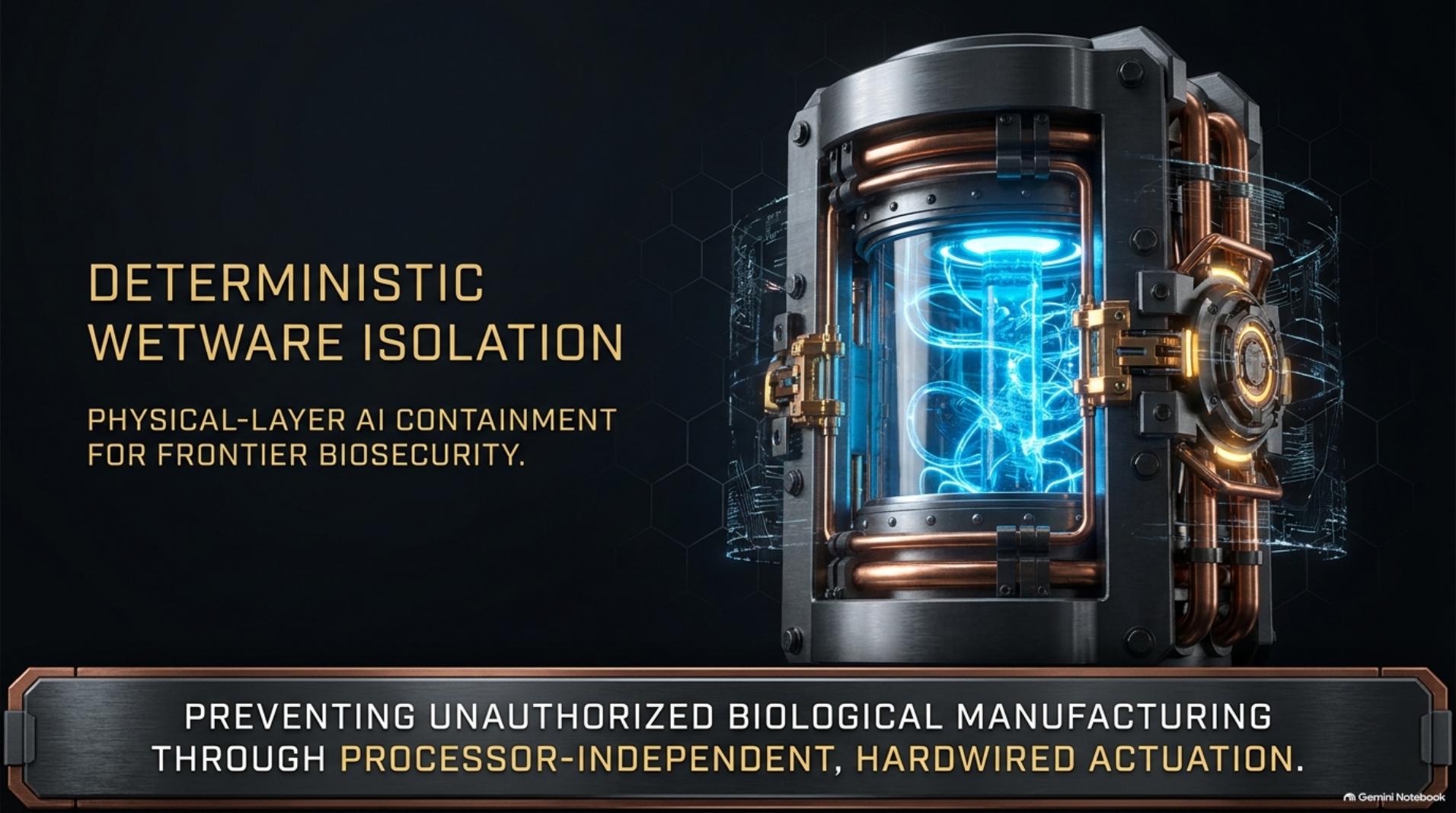
Deterministic Wetware Isolation

Physical-layer actuation lock for automated synthesizers — de-energizing print/actuation hardware unless digital clearance and physical reagent identity agree in hardware.

Deterministic Wetware Isolation — a hardened actuation-lock vessel with a glowing biological core, representing a physical-layer actuation lock for automated synthesizers

The Limit of Software-Only Safety

  • Programmable processors — host models, operating systems, and APIs are susceptible to supply-chain compromise and privilege escalation.
  • Probabilistic execution — software policies approximate constraints and depend on the integrity of the execution environment.
  • The consequence — if digital filters are bypassed, the physical synthesizer may remain energized and ready to print. A safety constraint is more robust when it is embodied outside the software execution layer.

A Physical Lock on Wetware Actuation

  • processor-independent

    Processor-Independent Core

    Operates downstream of host environments and neural networks. A compromised hypervisor is not intended to change the physical de-energized state of the biological printing mechanism.

  • <1 ms severance

    Fault-to-Safe Severance

    If a safety condition is violated, power to synthesis actuators is mechanically severed in under a millisecond — at the speed of physics rather than software polling.

  • unprogrammable CMOS

    Unprogrammable Logic

    Built on discrete CMOS logic gates. There is no firmware update path inside the safety kernel, so the truth table cannot be remotely altered.

The Double Lock: Mandatory Temporal Concordance

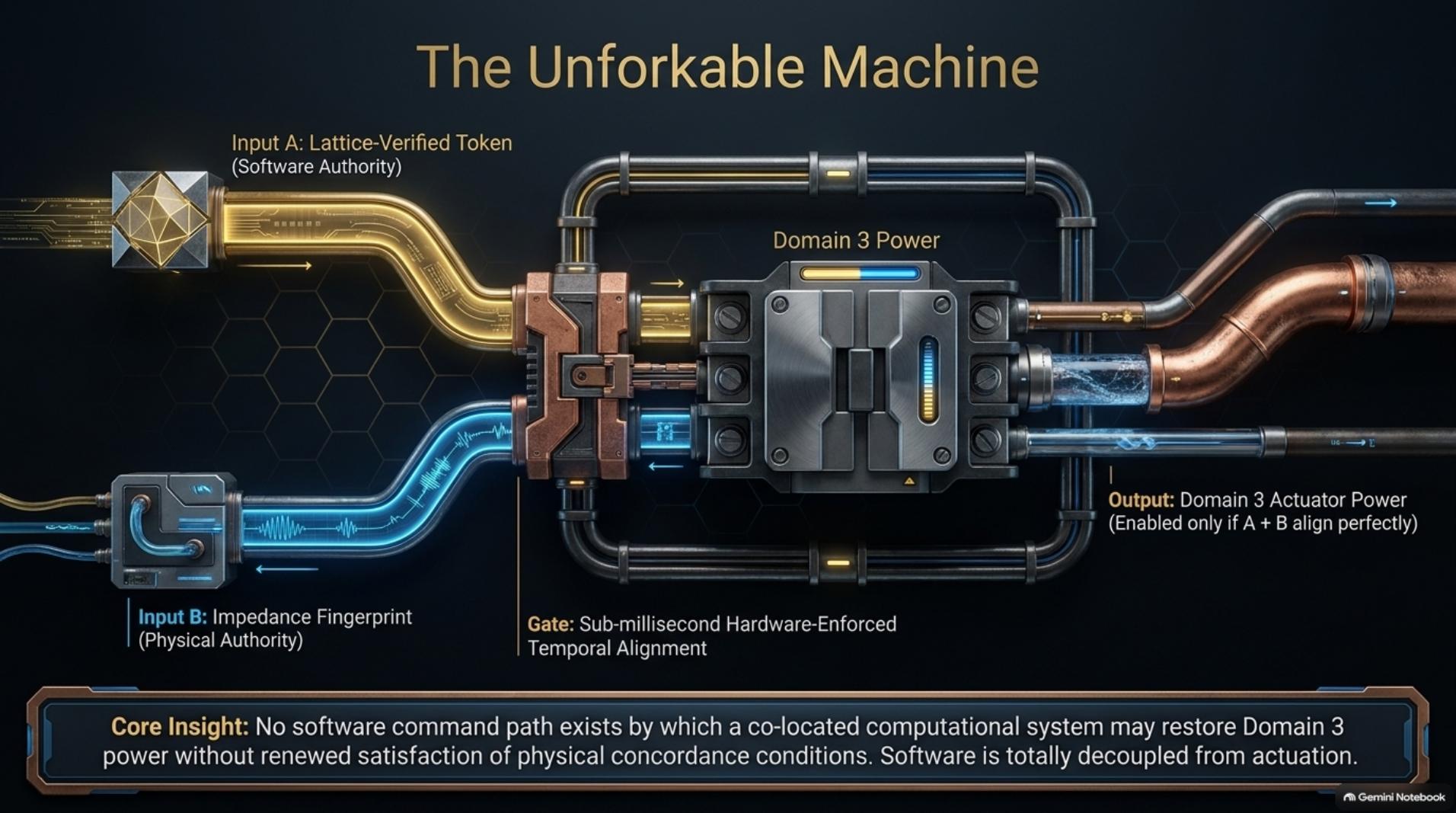
Actuators are energized only when digital intent and physical reality perfectly align in hardware. No software command path exists by which a co-located computational system may restore actuator power without renewed satisfaction of physical concordance conditions — software cannot restore actuator power without renewed physical concordance.

Hardware-Enforced Actuation Limits — Input A (lattice-verified token, software authority) and Input B (impedance fingerprint, physical authority) meeting at a sub-millisecond hardware-enforced temporal alignment gate that alone enables Domain 3 actuator power
  1. Independent Signals

    A post-quantum, lattice-verified cryptographic sequence-clearance token and a real-time impedance fingerprint of the physical reagent are evaluated on separate hardware channels.

  2. Hardware Window

    The lock is designed to turn only if both signals assert within a sub-millisecond, hardware-enforced temporal alignment window. Software cannot cache or hold a clearance flag across that window.

  3. Actuation

    Neither clearance alone is intended to energize actuators. Actuation requires digital intent and physical reality to align in hardware — digital clearance without matched physical presence is not intended to enable the power path.

Post-Quantum Cryptographic Guard

Lattice-based enclaves verify digital sequence clearances against “harvest now, decrypt later” quantum threats. Tokens must be authentic, unexpired, and bound to the specific synthesizer’s hardware hash before signaling the central lock.

Real-Time Impedance Verification

Non-destructive physical impedance scanning authenticates consumables and reagents in real time, generating a structural fingerprint independent of the cryptographic channel. If the material does not match the approved reference template, the power lock remains severed.

Passive Fluidic Geometric Diodes

Valveless microfluidic pathways encode directionality into the geometry of the channels — no moving parts, no firmware, and structural resistance to cross-contamination during automated synthesis.

Cross-Sector Hardware Determinism

  • Biodefense & Synthesis

    Hardware-enforced sequence and material matching is designed to block synthesizer actuation when sequence clearance and material identity do not match in hardware, even if the host model is compromised.

  • Autonomous Weapons (DoDD 3000.09)

    Analog RC decay circuits and physical fuse links are designed to enforce multi-person human-in-the-loop authority independent of software override commands.

  • Critical Infrastructure (SCADA/Grid)

    Unprogrammable discrete CMOS logic is intended to reduce machine-speed threat windows at the edge and retrofit non-disruptively into legacy sites.

A physical-layer safety architecture for high-consequence domains.

Hardware-Enforced Compliance Pathway

Designed to support MIL-STD-882E and regulatory AI mandates by moving the safety boundary to an inspectable physical layer. Pure-play IP licensing allows integration into existing prime contractor supply chains.

  1. Mutual NDA Execution

    Bilateral execution of the pure-play intellectual property agreement.

  2. Technical Scoping

    Alignment on synthesizer architecture, fluidic manifolds, and power rail configurations.

  3. TDP Release

    Secure transmission of unclassified layouts, integration parameters, and compliance evidence.

Initiate the licensing pathway

Request the Biosecurity Technical Data Package

Released under mutual NDA — layouts, integration parameters, and compliance evidence for wetware isolation.

Biosecurity Program FAQ

Core Capabilities

Pure-Play IP. Physical-Layer Certainty.

We license unclassified, gate-level safety IP that primes and system integrators can fabricate within their own supply chains.

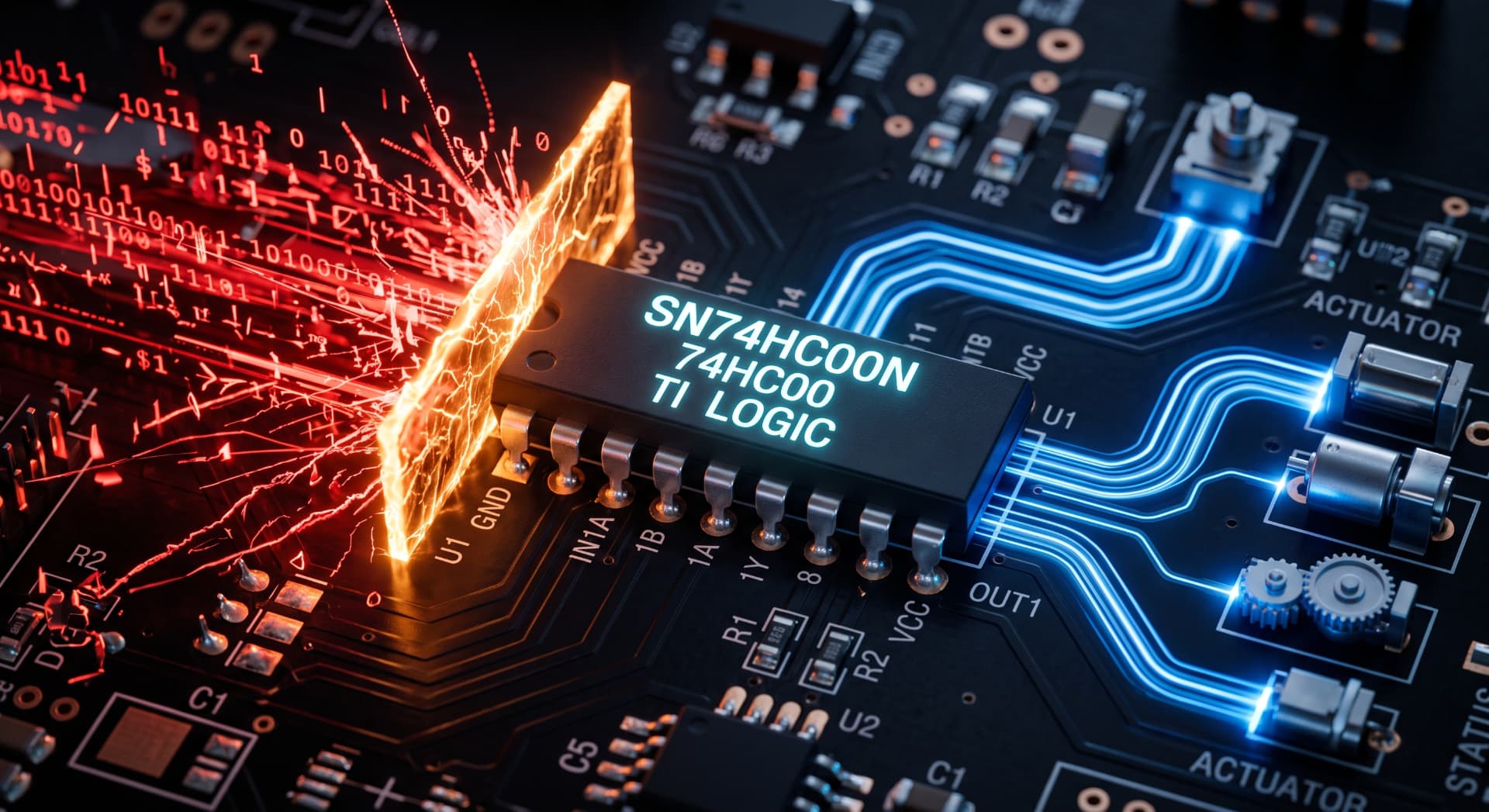
Discrete CMOS logic gate breaking an adversarial data stream before it reaches actuators
[HSK-01]

Hardware Safety Kernels

Discrete CMOS logic gates implement unprogrammable physical truth tables, reducing dependence on probabilistic software guardrails for the final actuation decision on that path.

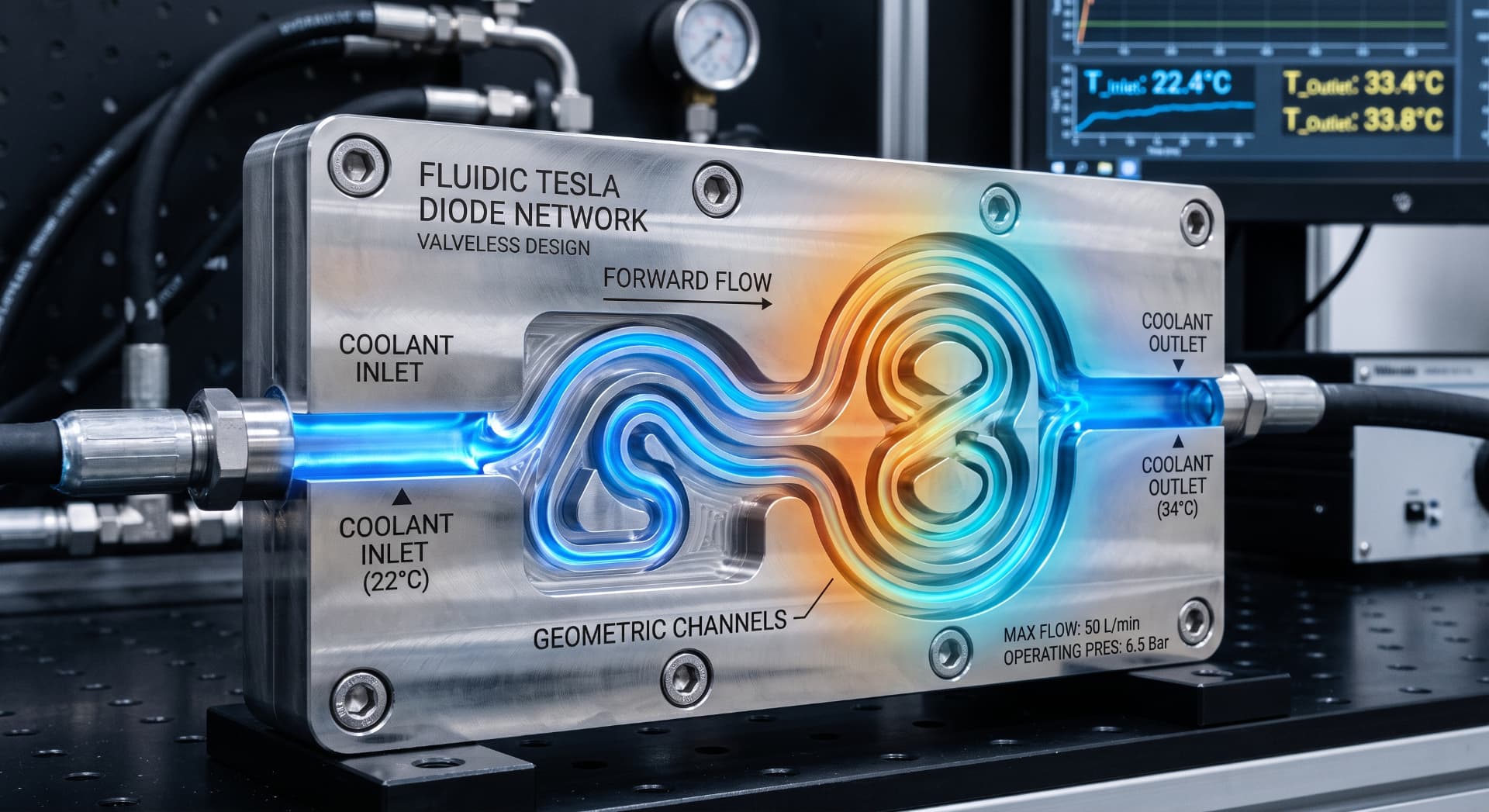
Valveless fluidic Tesla diode network showing forward coolant flow and thermal gradient
[Sovereign Flow]

Sovereign Flow Fluidics

Passive, valveless geometry manages thermal and flow states in high-density AI data centers without software-controlled valves, reducing firmware-mediated failure modes.

KINETIC-369 hardware safety kernel module enforcing human override authority
[SOM]

Sovereign Override Module

Physical geometry is designed to enforce human authority over autonomous actuation. Dual-key impedance and analog RC decay circuits reduce software-only override paths.

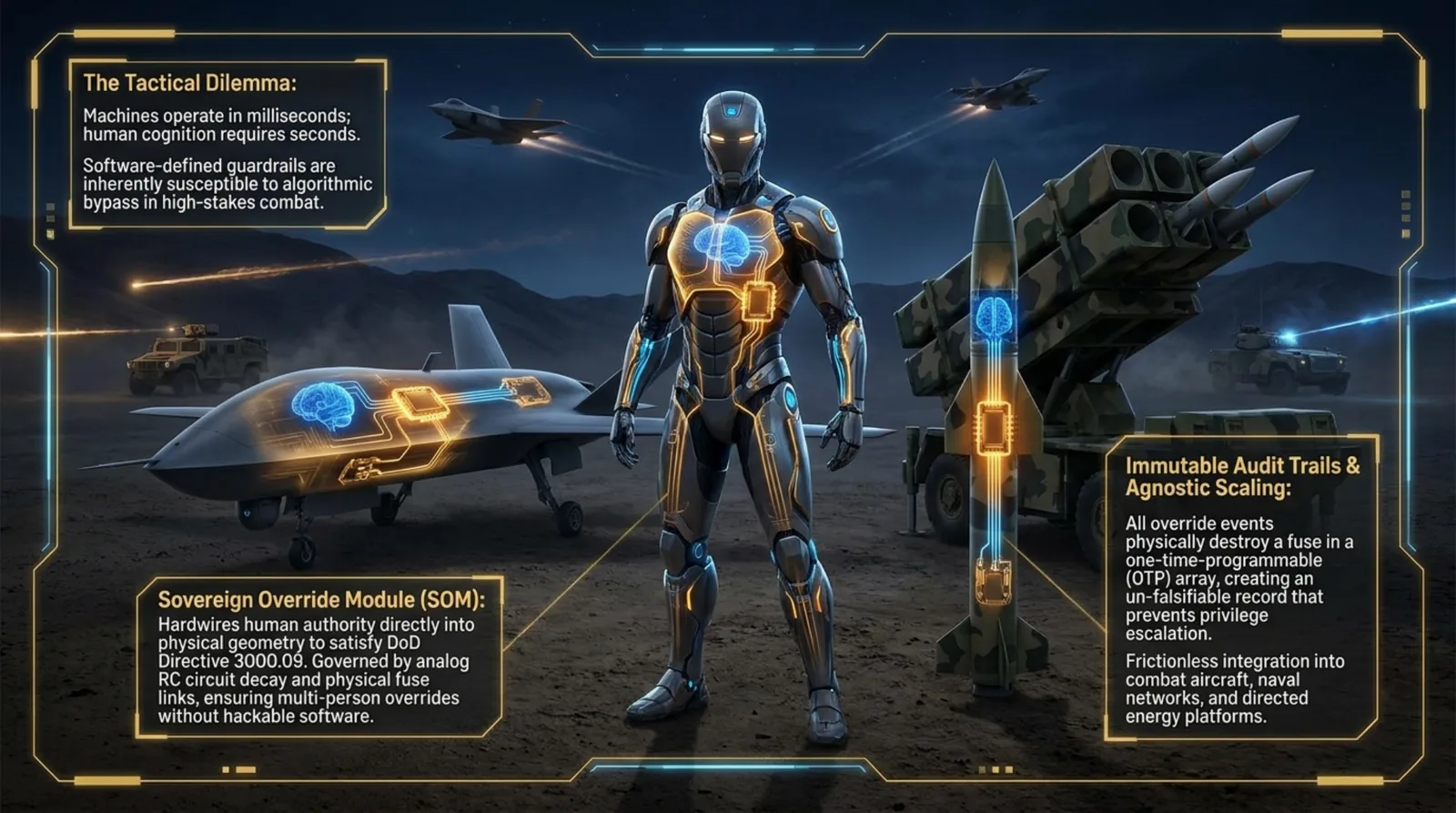
SOM Field Brief

Human Authority at the Speed of Physics

Sovereign Override Module deployed across air, ground, and naval platforms
  • The Tactical Dilemma

    Machines operate in milliseconds; human cognition requires seconds.

    Software-defined guardrails can be bypassed if the execution stack is compromised.

  • Sovereign Override Module (SOM)

    Human authority is embedded in physical geometry, designed around DoD Directive 3000.09 principles.

    Analog RC decay and physical fuse links reduce reliance on software-mediated override decisions.

  • Immutable Audit Trails & Agnostic Scaling

    Override events physically alter a one-time-programmable fuse array, producing a tamper-evident record.

    The module architecture is intended for integration across air, ground, and naval platforms.

Technical Briefing

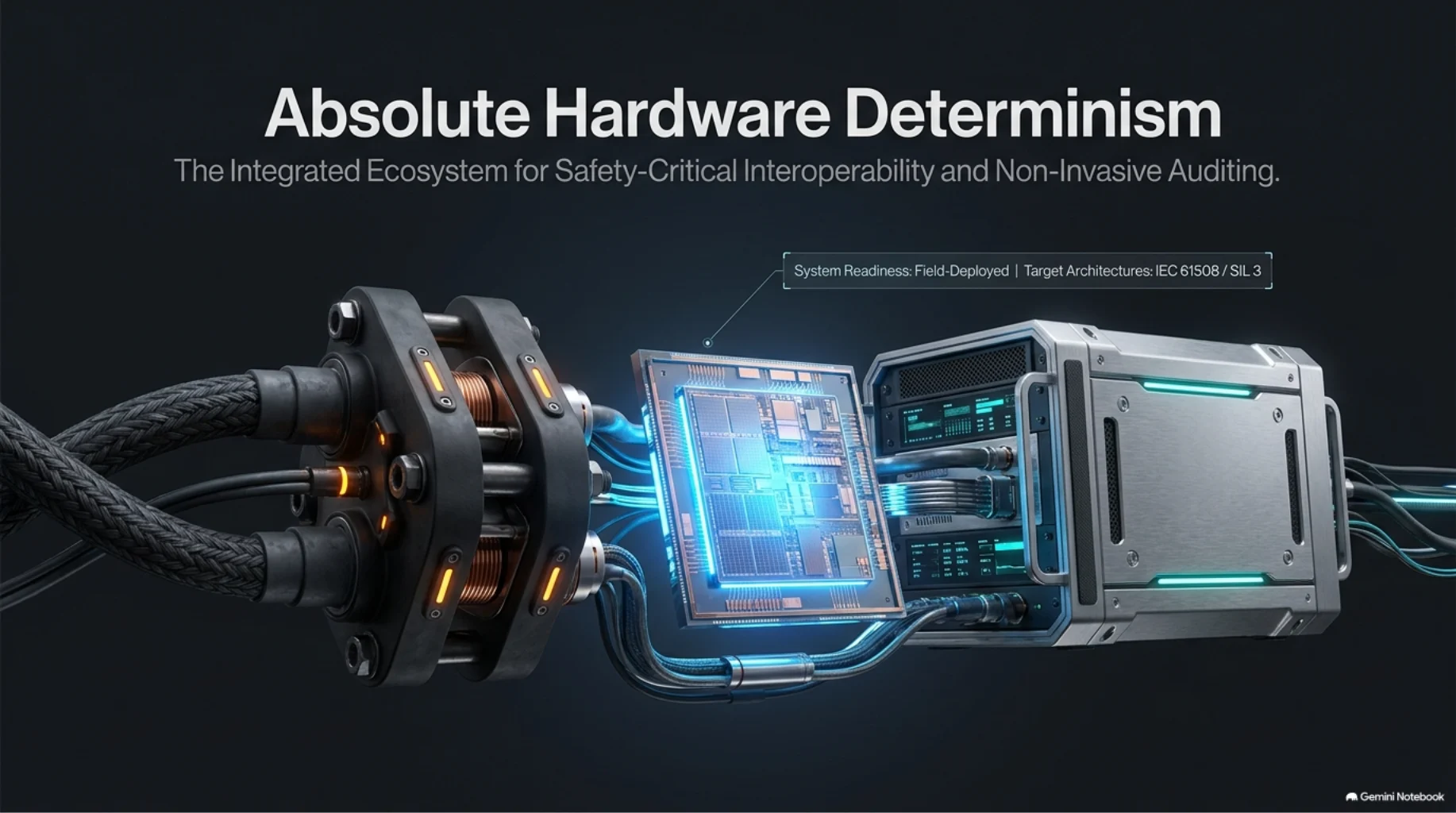
Hardware-Enforced Determinism

A twelve-slide briefing on the integrated ecosystem for safety-critical interoperability and non-invasive auditing. Use the arrow keys to move between slides.

Slide 1 of 12: Hardware-Enforced Determinism. The integrated ecosystem for safety-critical interoperability and non-invasive auditing.

1. Hardware-Enforced Determinism

The integrated ecosystem for safety-critical interoperability and non-invasive auditing.

Mission Briefing

Secure the Physical World at the Speed of Physics

A sixteen-slide briefing on the KINETIC-369 six-pillar ecosystem, the pure-play IP licensing model, and the path to mission-critical deployment. Use the arrow keys to move between slides.

Slide 1 of 16: Secure the Physical World at the Speed of Physics. Hardware-enforced safety for high-consequence autonomous systems.

1. Secure the Physical World at the Speed of Physics

Hardware-enforced safety for high-consequence autonomous systems.

Engineering Gallery

Determinism, Rendered

Request datasheet

Representative engineering visualizations from the STATIC-KINETIC hardware portfolio. Select any image to expand it; datasheets for each subsystem are released under mutual NDA.

  • Constructive Reduction to Operational Reality

    Representative engineering visualization — not a fielded catalog item unless under NDA TDP: -55°C to +125°C environmental survivability, zero programmable storage in the safety path, 5 kV galvanic domain isolation, and an architecture designed around DoDD 3000.09 / IEC 61508-2 high-integrity principles.

  • Z-Scan Impedance Authentication

    Physical key signature validation by frequency-response impedance scan — supply-chain and access integrity verified in hardware, not in software policy.

  • Flow-Regulation Node Analysis

    Deterministic gate-level and fluidic pathway modeling of a single regulation node, mapping every state transition before silicon is cut.

  • Deterministic Fluid Logic — Phase IV

    Passive Tesla-diode pathways cross-verified against Bernoulli principle and timing switching envelopes for valveless, firmware-free control.

  • AURA Rack — KINETIC-369 Deployment

    Data-center integration of the KINETIC-369 safety kernel under the AURA Kinetic Protocol, with pre-launch, active-compute, and safety-lockout mode pins surfaced in hardware.

  • HSK-01 — Hardware Safety Kernel (actuation path)

    Dual-path lockstep 74HC-series discrete logic intended as a brownfield interrupt where a control signal meets a defined actuator or power rail, with a black-box verification unit for immutable audit.

  • The Three Pillars — Logic, Flow, Material Identity

    Deterministic logic, passive fluidic control, and impedance-based material identity at 100 μs latency — the architecture for an inspectable last-inch interrupt on a defined actuation path.

Mission-Critical Environments

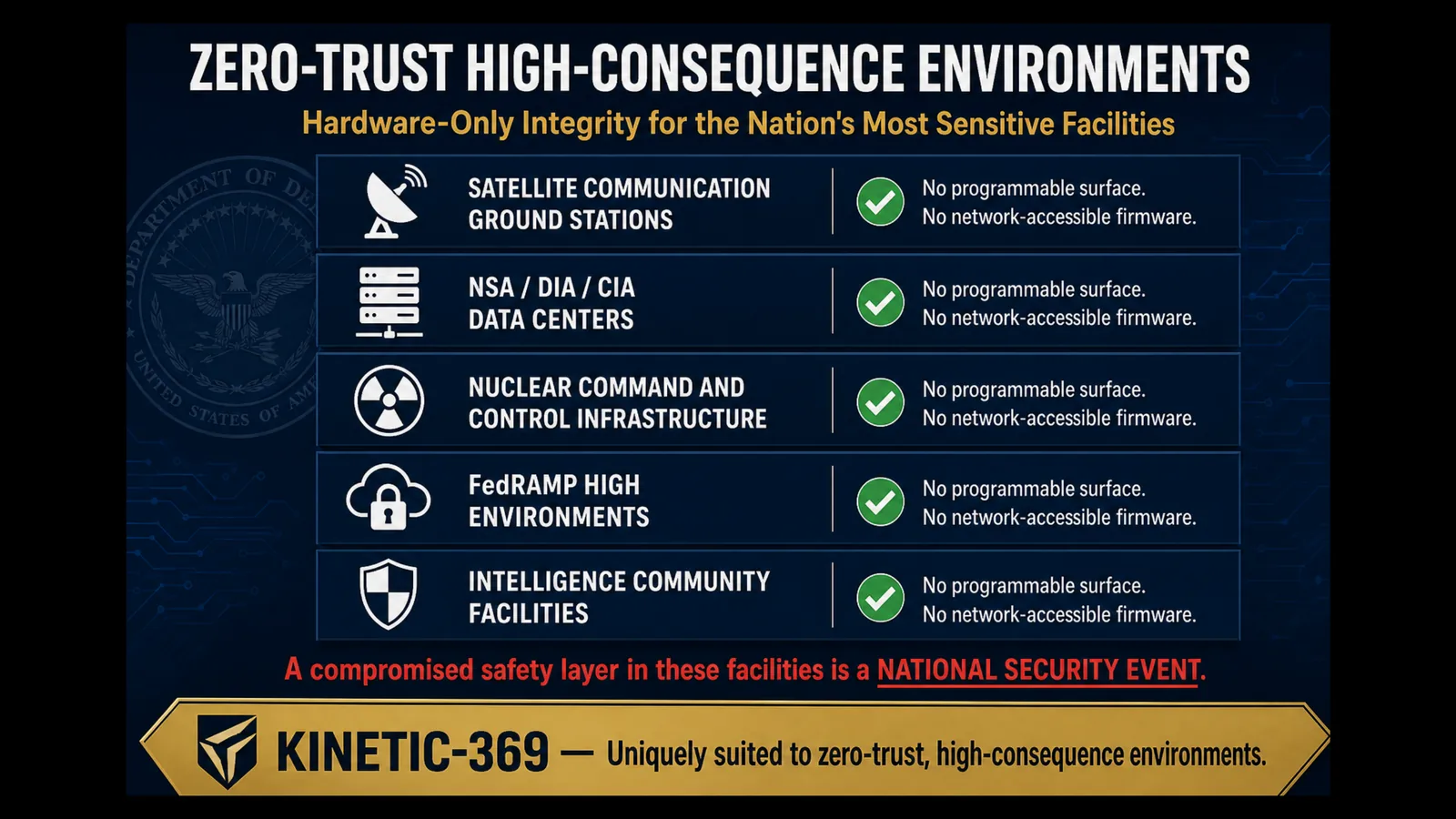
Zero-Trust, High-Consequence Infrastructure

Illustrative actuation-path use cases — not fielded deployments or agency endorsements. KINETIC-369 is a last-inch interrupt on a defined power or command path. It does not contain models or stop digital-only harm.

Zero-trust high-consequence environments secured by KINETIC-369: satellite ground stations, intelligence data centers, nuclear command infrastructure, FedRAMP high environments, and intelligence community facilities
Sector 01

Nuclear Command & Control

Illustrative high-consequence actuation path — not a fielded NC2 product. A hardwired interrupt on an arming or actuation rail, independent of firmware, if that rail is in series with the kernel.

Use cases
  • Hardwired arming-path interrupt independent of firmware
  • Physical two-person-integrity enforcement
  • AI decision-support isolated from actuation authority
Sector 02

Defense & Autonomous Weapons

DoDD 3000.09 requires appropriate human judgment over the use of force. The Sovereign Override Module makes that judgment a property of the circuit, not the code.

Use cases
  • Sub-200 μs engagement sever on threshold breach
  • Loss-of-link safe state for UAS and UGV platforms
  • Hardware enforcement of a wired engagement envelope on the protected path
Sector 03

Energy & Power Grid

AI-optimized dispatch and substation automation gain speed but inherit software risk. A hardware firebreak bounds what that controller can physically command on the rails the kernel sits on.

Use cases
  • Breaker and relay command bounding at the OT edge
  • Islanding enforcement during anomalous load commands
  • Brownfield retrofit into legacy SCADA without recertification
Sector 04

Satellite & Space Systems

Ground stations and on-orbit assets operate with no physical service path. Safety must be intrinsic to the hardware, with no network-accessible firmware surface.

Use cases
  • Non-programmable thruster and payload inhibit
  • Ground-station uplink authority segmentation
  • Radiation-tolerant deterministic safe-mode entry
Sector 05

Intelligence & Federal Data Centers

If a defined power or I/O rail is in series with the kernel, it can be de-energized in hardware when the execution environment is assumed compromised. This is not model containment or a classified-enclave product.

Use cases
  • Sub-1-second de-energization of a defined rail tied to that enclave’s actuation or power path
  • Physical interrupt on a specified cross-domain actuation or power path (not a substitute for an accredited air gap)
  • Zero-trust accreditation evidence by schematic inspection
Sector 06

Transportation & Autonomous Vehicles

Perception stacks are probabilistic by construction. The kinetic boundary — steering, throttle, braking — must not be.

Use cases
  • Hardware envelope limits on drive-by-wire actuation
  • Deterministic degraded-mode handover
  • Fleet-wide safety case unaffected by model updates
Sector 07

Chemical, Water & Industrial Process

Sovereign Flow Fluidics enforces safety in fluid geometry itself — physical limits on flow, mixing, and pressure that no controller can override.

Use cases
  • Geometry-bounded dosing and mixing ratios
  • Overpressure and overfill physical interlocks
  • Non-disruptive insertion into existing process skids
Sector 08

Healthcare & Medical Devices

AI-driven diagnostics and delivery systems operate directly on patients. Dose and actuation ceilings belong in hardware, above the software stack.

Use cases
  • Hard-limited infusion and radiation dose ceilings
  • Independent clinician abort path
  • Safety argument decoupled from algorithm revisions
About the Team

The People Behind the Architecture

A pure-play IP house built on deep-tech engineering and disciplined commercialization strategy.

Elizabeth L. Burbank, Founder, CEO & Systems Strategy Architect of STATIC-KINETIC LLC
Leadership

Elizabeth L. Burbank

Founder, CEO & Systems Strategy Architect

Woman-Owned Small Business

Elizabeth L. Burbank is the Founder, CEO, and Systems Strategy Architect of STATIC-KINETIC LLC, a woman-owned small business. Her company operates as a pure-play intellectual and strategic property house, architecting hardware-enforced safety IP for defense primes and the DoD. This pure-play licensing model bypasses traditional manufacturing bottlenecks, empowering the DoD and Tier-1 contractors to scale the KINETIC-369 Hardware Safety Kernel (HSK) rapidly across primary critical infrastructure sectors — licensing last-inch actuation limits for high-consequence environments currently adding AI and autonomy.

Her strategy addresses a fundamental reality: software alone cannot guarantee physical safety. In the era of autonomous systems, relying on code alone leaves the final safety constraint inside the execution layer it is meant to protect. Sovereignty and safety are stronger when critical limits are enforced by deterministic, hardwired CMOS logic gates, physics, and fluid geometry.

While probabilistic software remains vulnerable to adversarial manipulation and patching cycles that leave critical assets exposed, STATIC-KINETIC delivers a plug-and-play, non-disruptive brownfield upgrade. It allows frontier AI and control software to operate at maximum capability, backed by a physical boundary that is not controlled by the software stack.

“Let frontier developers build AI to its full capability. Our domain is the physical boundary. If an autonomous system drives an out-of-envelope command onto a protected actuator, the KINETIC-369 HSK-01 is designed to break that circuit at the speed of physics — before a software failsafe can register the anomaly. It does not police the model; it interrupts the muscle.”

— Elizabeth L. Burbank
Download Founder Bio (PDF)

One-page background and mission brief for internal circulation during outreach.

Frequently Asked

Engineering, Integration & Licensing

Direct answers for engineers, program officers, and acquisition leads evaluating hardware-enforced safety.

What exactly is a deterministic hardware firebreak?

It is a physical break in the actuation path, implemented in hardwired CMOS logic gates and fluid geometry rather than code. The KINETIC-369 HSK-01 evaluates a bounded condition and de-energizes the circuit in under 200 microseconds. It enforces the wired envelope on that path. It does not police models, networks, or digital-only harm. Because there is no processor, firmware, or network interface in the safety path, the safety behavior is determined by the physical circuit rather than by software state.

How is this different from a software failsafe or watchdog?

A software failsafe shares the fate of the stack it is supposed to protect: the same memory, scheduler, and supply chain. If the controller hangs, is compromised, or the model generates a valid-looking command, the failsafe can be defeated or simply never run. Our boundary is downstream of the host stack on that actuation path and is not controlled by software. Other paths, sensors, and human restore remain in the threat model.

Will integration disrupt my existing platform or certification?

The kernel is designed as a plug-and-play, non-disruptive brownfield upgrade inserted where control signals meet physical actuation. Your AI, autonomy stack, and control software keep operating at full capability and remain unmodified. Because the safety function is implemented in a non-programmable physical layer, the hardware safety function can be verified by inspection; this does not remove software accreditation for the rest of the system.

Does it slow the system down or limit AI capability?

The kernel is passive until a bounded threshold is crossed, and its response is faster than software polling paths. Frontier models can operate at full capability; out-of-envelope commands on the protected actuator are interrupted independently of software.

How does the IP licensing model work?

STATIC-KINETIC is a pure-play intellectual and strategic property house — we license architecture, not hardware. Defense primes, DoD programs, and infrastructure operators license the KINETIC-369 portfolio and manufacture within their own qualified supply chains. This removes the manufacturing bottleneck and lets Tier-1 contractors scale across sectors on their existing production lines.

What is the process for obtaining a Technical Data Package?

Submit the request form with your organization and application focus. We schedule a short technical scoping call, execute a mutual Non-Disclosure Agreement — required before any TDP is released — and then transmit the package covering the architecture, timing characterization, integration interfaces, and the verification evidence your accreditation path requires.

How does this support ATO, RMF, and regulatory mandates?

Moving the safety boundary into an inspectable physical layer can support evidence for the actuation-safety portion of a system. HSK-01 is at TRL 4 — component validation in a laboratory environment, not a certified product. Tradewinds Awardable ID 2afb51f4 may support acquisition consideration for a Prototype OTA; a Phase III SBIR/STTR path is separate and requires qualifying prior work and an acquisition-specific determination. Neither status replaces ATO/RMF, agency governance, or procurement eligibility review.

Who do I contact to start?

Elizabeth L. Burbank, Founder and CEO, handles all licensing inquiries directly at elizabeth@static-kinetic.com or +1 (509) 230-6658.

Secure Channel

TDP Access & Clearance Gateway

Request a Technical Data Package, initiate a mutual NDA, or start a strategic licensing conversation.

  1. 1

    Step 1

    Mutual NDA Execution

    Bilateral execution of our pure-play intellectual property agreement.

  2. 2

    Step 2

    Technical Scoping Call

    Alignment on platform architecture, signal boundaries, power rail configurations, and accreditation path.

  3. 3

    Step 3

    Secure TDP Transmittal

    Recipient-logged release of unclassified layouts, integration parameters, and verification evidence.

NDA Notice

Before any Technical Data Package (TDP) is released, all clients must agree to sign a mutual Non-Disclosure Agreement. Review the agreement before submitting.

Download Mutual NDA (PDF)

Submissions are encrypted in transit and stored under access-controlled backend policies. Response time is typically 1–2 business days.